


勇者义彦与魔王城
Exclusive: ‘Like ripples on the sea’: Chinese astronomer tells Global Times how the Milky Way got its newly discovered ‘wrinkles’_我的网站

一 |
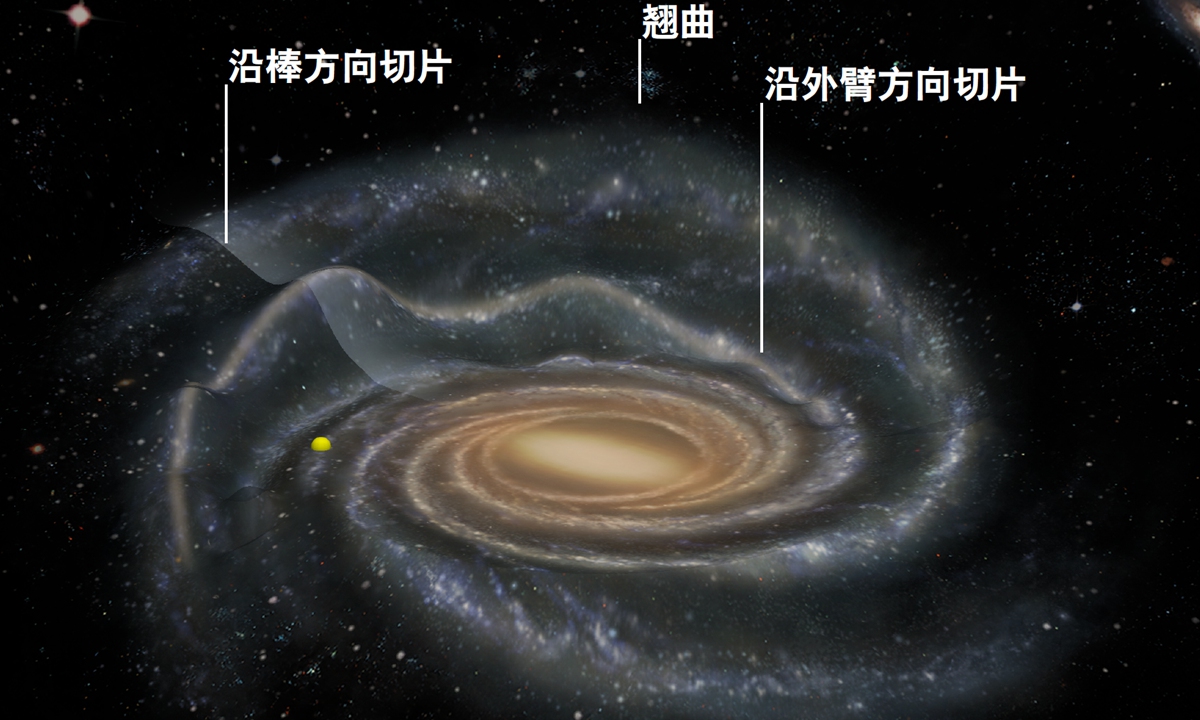
Chinese astronomers have discovered that the Milky Way is not a simple, smoothly warped disk, but contains widespread "wrinkle-like" structures resembling ripples on a water surface, providing new clues to understanding the galaxy's 3D structure and evolutionary history.
The discovery was made by a research team from the Purple Mountain Observatory (PMO) under the Chinese Academy of Sciences, using data from the "Milky Way Imaging Scroll Painting" (MWISP) survey. The findings were published online titled "Widespread corrugations superimposed on the Galactic warp in the outer CO disk" in the journal Nature Astronomy on August 7.
For decades, astronomers have known that the Milky Way's disk is not perfectly flat. Instead, its outer regions are slightly bent upward on one side and downward on the other - a structure known as a galactic warp.
However, the latest study shows that this large-scale bending is not the whole story. Smaller-scale vertical fluctuations are also embedded within the warped disk, creating a more complicated 3D structure.
"In many illustrations and in the public imagination, the Milky Way looks like a flat vinyl record," Sun Yan, associate researcher at PMO and the first author of the paper, told the Global Times on Tuesday. "In reality, the outer part of the Milky Way is more like a record that has been heated and deformed, with one side lifted and the other side lowered. That is the warp. On top of this large-scale deformation, there are additional smaller waves, which we call corrugations," Sun explained.
Using a more everyday analogy, Sun compared the Milky Way's structure to a sea surface. The warp is like a large swell that changes the overall height of the ocean, while corrugations are smaller waves superimposed on that swell.
"The two structures exist together. In our data analysis, we first removed the large-scale warp model, which allowed us to reveal the smaller wave-like patterns hidden underneath," Sun said.
The research focused on the Milky Way's outer gas disk rather than the more familiar stellar disk. According to Sun, cold molecular gas and stars provide two complementary ways to study the galaxy.
"Molecular gas is a sensitive probe for studying the vertical structure and dynamics of the galactic disk because it is concentrated near the disk plane and responds strongly to disturbances," she said.
Molecular gas is also the raw material for star formation, meaning its distribution is closely connected with the formation of young stars. The researchers traced this gas through carbon monoxide (CO) emission, which can penetrate regions obscured by interstellar dust and provide a different perspective from optical observations of stars.
The breakthrough was made possible by the MWISP survey, conducted using China's 13.7-meter millimeter-wave telescope.
"MWISP can be understood as giving the Milky Way a large-scale medical examination using millimeter-wave observations," Sun said.
Previous CO surveys were limited in sensitivity and coverage, making it difficult to accurately study the distant outer regions of the galaxy. In contrast, the latest study identified more than 30,000 molecular cloud samples, covering about half of the Milky Way's outer disk and extending to a distance of about 26 kiloparsecs from the Galactic center.
With such a large dataset, researchers were able to first establish a model of the overall warp and then separate subtle structures from the background. The newly identified corrugations have radial wavelengths of about 3.9-7.9 kiloparsecs and vertical amplitudes of about 100-200 parsecs.
The study also identified a corrugation structure extending about 40 kiloparsecs in azimuth at a distance of around 12.7 kiloparsecs from the Galactic center. In some spiral arm regions, vertical displacements can reach approximately 200 parsecs.
The researchers believe these large-scale vertical fluctuations are likely related to "bending waves" triggered by external gravitational disturbances, suggesting that the Milky Way might have experienced more complex interactions during its evolutionary history.
Although the newly discovered structures sound dramatic, they do not have any direct impact on Earth or the solar system. "Humans cannot directly sense these corrugations," Sun said. "Their scales reach thousands or even tens of thousands of light-years, and even if these structures are evolving, such changes would not be directly perceptible on human timescales."
The study focuses on the outer disk of the Milky Way and does not include the region around the solar system. "There is currently no evidence that these structures have any observable influence on Earth's environment," Sun said.
Instead, their significance lies in what they reveal about the past. Like geological layers recording Earth's history, these galactic structures preserve traces of the Milky Way's evolutionary journey, the researchers explained.
Researchers said future studies combining more precise motion measurements and numerical simulations could further reveal the origins of these structures and their role in the long-term evolution of the Milky Way.
。 Breakthrough new research could significantly increase supply of organs for people with rarer blood types waiting for a transplant, reported The Guardian.,A team of scientists from the University of Cambridge have successfully altered the blood type of three donor kidneys. By flushing blood infused with a special enzyme through a human kidney the scientists removed the blood type markers lining the blood vessels of the organ.,The procedure required using a device that is connected with a donor’s kidney to pass oxygenated blood through it - a normothermic perfusion machine. As a result, the organ was converted to type O, considered the universal donor.,Blood Group Compatible,As the blood type of a donor must be compatible with the recipient’s, the new development could increase the supply of kidneys available for transplant.,A kidney from someone with blood type A cannot be transplanted to someone with blood type B, or visa versa. In such a case, the receiving body’s immune system would reject the new organ, interpreting the different blood type as foreign.,So changing the blood type to the universal O would mean the donor organ could be used for people with any blood type.,“Our confidence was really boosted after we applied the enzyme to a piece of human kidney tissue and saw very quickly that the antigens were removed. After this, we knew that the process is feasible, and we just had to scale up the project to apply the enzyme to full-size human kidneys,” Serena MacMillan, a PhD student at the University of Cambridge, said.,Scientists involved in the research, funded by charity Kidney Research UK and due to be published in the British Journal of Surgery, clarified that the outcome might have particular implications for minority ethnic groups.,Science & TechGood News for ABs: Scientists Can Now Change People's Blood Type21 February, 16:34 GMT,Some blood groups such as O Rh positive and B Rh positive are more prevalent among black, Asian and minority ethnic communities. To complicate matters further, some rare blood types are only found within the black, Asian and minority ethnic communities,This typically places them at a disadvantage, as they struggle to find a match. With low donation rates from these populations, stressed the researchers, sometimes such patients wait for as long as over a year for a compatible donor. They cited figures from 2020-21 showing that just over 9% of total organ donations in the UK came from black and minority ethnic donors. On the other hand, black and minority ethnic patients make up 33% of the kidney transplant waiting list.,“It’s very exciting to think about how this could potentially impact so many lives,” added Serena MacMillan.,The “potentially gamechanging” research was applauded by Dr Aisling McMahon, the executive director of research at Kidney Research UK.,The scientists will now test the reintroduction of other blood types and observe how the novel approach in clinical settings.。
Current article:http://xsu7m6.cesangrangshunzashuangruijiu.pics/news/20260826_3610.html
Published on:03:45:23
 东戴河新区研究部署重点工作
 新西兰拟立法禁不满16岁者使用社媒
 奇瑞多米/小蚂蚁喜爱版/冰淇淋元气版上市 售3.99万起 QQ家族壮大
 Major solar panel plant opens in US amid backdrop of industry worries about imports
 从“到此一游”转向深度体验 暑期休闲,这些玩法人气高(探访·暑期消费)
 夏季玩水选哪双鞋?
 国内品牌金饰克价重回1400元
 定档!南马十年!2026南京马拉松开启报名,全新规则速看
 特斯拉Cybertruck电池组将在弗里蒙特工厂制造
 陈武同志逝世
 Pakistan ‘one of the most dangerous nations’: Biden
 北上广最挤的地铁线,人开始变少了?